
Kuala Lumpur is one of the cheapest capital cities in Southeast Asia for travellers. Street food costs as little as RM4 (about USD 1), public transport fares start from RM1, and many of the best attractions are completely free.
The city has world class skyscrapers, colourful temples, massive shopping malls, excellent food from three major cuisines (Malay, Chinese, and Indian), and a public transport system that actually works. You can see most of the highlights in five days without spending much at all.
Kuala Lumpur on a budget guide covers everything you need to plan a budget trip to Kuala Lumpur, including how to get around, what things cost, where to eat and stay, free and cheap things to do, and a day by day itinerary that makes practical sense.
How Much Does Kuala Lumpur Cost Per Day?
Here is a realistic daily budget for Kuala Lumpur based on what things actually cost in 2026.
Budget traveller (RM100 to 150 per day / USD 25 to 37)
Hostel dorm: RM25 to 50 per night. Three meals at hawker centres and street stalls: RM25 to 40. Public transport: RM5 to 15. One paid attraction or activity: RM5 to 20.
Mid range traveller (RM250 to 350 per day / USD 62 to 87)
Private room in a budget hotel: RM80 to 150. Meals at a mix of hawker centres and restaurants: RM50 to 80. Public transport plus occasional Grab rides: RM20 to 40. Two or three paid attractions: RM50 to 100.
These numbers assume you are not visiting the most expensive attractions every day. The Petronas Twin Towers (RM98) and KL Tower (RM80) are worth doing once, but you do not need to spend that much daily. Many of the best things to see in KL are free.
The Malaysian Ringgit (RM) is the local currency. As of 2026, 1 USD equals roughly 4 RM. Most places in central KL accept card payments, but you will want some cash for street food vendors, hawker centres, public transport token machines, and smaller shops.
Getting to Kuala Lumpur
Flying In
Kuala Lumpur International Airport (KLIA) is the main gateway. It has two terminals: KLIA (for full service airlines like Malaysia Airlines) and KLIA2 (for budget airlines like AirAsia). Both are about 55 km south of the city centre.
Airport to City Centre
You have three main options to get from the airport to central KL.
KLIA Ekspres (fastest): A direct train from KLIA to KL Sentral station. The journey takes 28 minutes from KLIA and 31 minutes from KLIA2. Trains run every 20 minutes throughout the day. A single adult ticket costs RM55 one way or RM100 return. Children aged 6 to 15 pay RM25 one way. Book online or through the KLIA Ekspres app for 10% off.
Airport bus (cheapest): SkyBus and Aerobus both run from KLIA and KLIA2 to KL Sentral. The fare is around RM13 one way. The journey takes roughly 1 hour to 1 hour 15 minutes depending on traffic. Buses run frequently from early morning until past midnight.
Grab (most convenient): A Grab ride from the airport to central KL costs roughly RM80 to 120 depending on traffic, time of day, and your exact destination. This only makes sense if you are sharing with others and splitting the fare.
For budget travellers, the airport bus is the clear winner. You save over RM40 compared to the express train, and the extra 45 minutes is a fair trade.
Getting Around Kuala Lumpur

KL has an extensive public transport network and most tourist attractions are within walking distance of a train station.
MRT, LRT, and Monorail: These three rail systems cover most of central KL. A single trip costs RM1 to RM7 depending on distance. The MRT Kajang Line and Putrajaya Line are the newest and cover the most ground. The Monorail runs through Bukit Bintang and connects to KL Sentral. Buy tokens from machines at every station, or tap in with a Touch ‘n Go card.
Touch ‘n Go card: Get one of these as soon as you arrive. It works on all trains, buses, and at many shops and restaurants. The card costs RM10 (non refundable) and you top it up with credit as needed. Available at convenience stores, train stations, and the airport. It saves time and avoids queuing for tokens at every station.
Go KL CityBus: These buses run 15 colour coded routes around the city centre. Each ride costs just RM1, payable only with a Touch ‘n Go card (no cash accepted). Buses run every 5 to 10 minutes from 6am to 11pm on weekdays and 7am to 11pm on weekends.
KTM Komuter: A suburban rail service useful for getting to Batu Caves (RM2.60 from KL Sentral, about 35 minutes) and Mid Valley Megamall.
Grab: The most popular ride hailing app in Malaysia. Short trips within central KL cost around RM8 to 15. Useful late at night or for reaching places that are not near a train station, like Thean Hou Temple.
Walking: The city centre is surprisingly walkable. You can cover Bukit Bintang, KLCC, Chinatown, Merdeka Square, and Little India on foot, though the heat and humidity mean you will want air conditioned breaks.
You do not need taxis in KL. Grab is cheaper, safer, and always uses a meter. If you do take a taxi, insist on using the meter or agree on a price before getting in.
Where to Stay on a Budget

The best areas for budget travellers are Bukit Bintang, Chinatown, and Chow Kit. All three are well connected by public transport and have plenty of affordable food nearby.
Bukit Bintang: The most popular area for tourists. Lots of hostels and budget hotels within walking distance of shopping malls, Jalan Alor (the main street food street), and the Monorail. Hostel dorms from RM25 to 50 per night. Budget hotel rooms from RM80 to 150.
Chinatown (Petaling Street area): Cheaper than Bukit Bintang and close to Pasar Seni MRT station. Good access to Central Market, Merdeka Square, and Masjid Jamek. Lots of street food and local restaurants. Hostel dorms from RM20 to 40.
Chow Kit: Less touristy, more local. The wet market here is one of the best in KL. Connected by the MRT and within walking distance of KLCC. Budget hotels from RM60 to 120.
Stay near a train station. This is the single most important tip for keeping transport costs low. A room that is a 5 minute walk from an MRT or LRT station will save you RM20 to 30 per day on Grab rides.
For specific hotel recommendations, see our guide to the best budget hotels in Kuala Lumpur.
Where to Eat on Kuala Lumpur on a Budget

Food is one of the best reasons to visit KL, and eating well here does not cost much at all. Malaysia’s three main communities (Malay, Chinese, and Indian) each contribute their own dishes, and you will find all three at most hawker centres.
What things cost:
Roti canai (flatbread with curry dip): RM2 to 3. Nasi lemak (coconut rice with sambal, egg, and sides): RM3 to 8 depending on toppings. Char kuey teow (stir fried flat noodles): RM6 to 10. Nasi kandar (rice with curries): RM8 to 15. Mee goreng (fried noodles): RM5 to 8. Teh tarik (pulled milk tea): RM2 to 3. Fresh fruit juice: RM3 to 5. A full meal at a hawker centre: RM8 to 15.
Where to eat:
Jalan Alor is the most famous street food destination in KL. It runs parallel to Jalan Bukit Bintang and comes alive every evening from around 5pm. The grilled chicken wings, satay, and stir fried noodles are popular. Prices are slightly higher than local hawker centres because of the tourist footfall, but still very affordable.
Hawker centres and food courts are where locals eat. Look for places that are busy with Malaysian families during meal times. Lot 10 Hutong (basement of Lot 10 Mall in Bukit Bintang) has well known stalls from across Malaysia. Madras Lane in Chinatown is good for Chinese hawker food in the morning.
Mamak restaurants serve Indian Muslim food 24 hours a day and are everywhere in KL. Roti canai, murtabak, nasi goreng, and teh tarik at any hour. These are some of the cheapest meals in the city.
For the best value, eat breakfast and lunch at hawker centres or mamak restaurants, and save one slightly nicer meal for the evening if your budget allows.
Free Things to Do in Kuala Lumpur
KL has more free attractions than most visitors expect. You could fill three or four days with free activities alone.

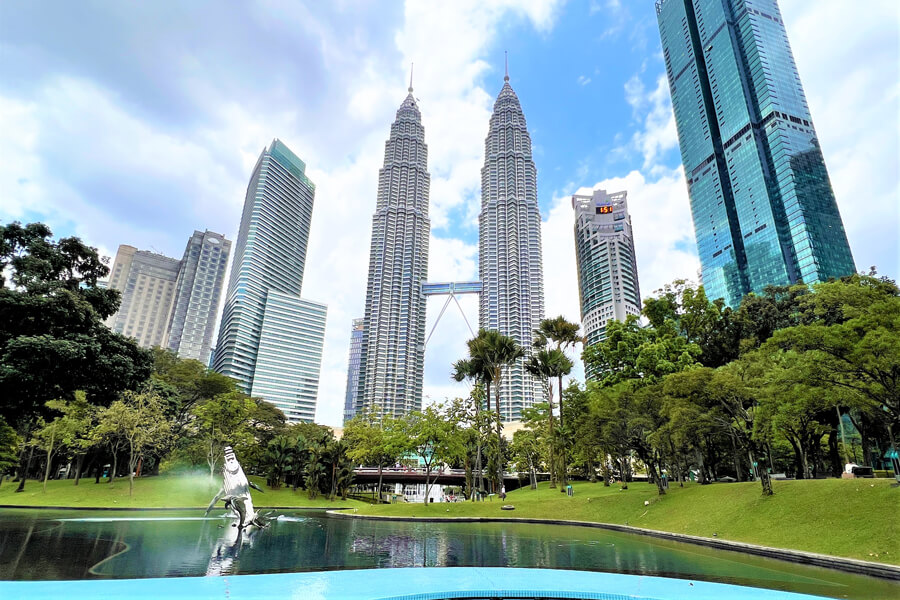
KLCC Park: A beautifully landscaped park at the base of the Petronas Twin Towers. The Lake Symphony fountain show runs nightly at 8pm, 9pm, and 10pm (with smaller light shows at 7:30pm, 8:30pm, and 9:30pm). Each show lasts about 10 to 15 minutes. The park also has a wading pool for children, jogging paths, and a playground. Free entry, open daily.

Batu Caves: A Hindu temple complex inside a limestone cave, reached by climbing 272 colourful steps. The main Temple Cave is free to enter. It is one of the most photographed places in Malaysia. Take the KTM Komuter from KL Sentral to Batu Caves station (RM2.60, 35 minutes). The station is right next to the cave entrance. Open daily from 6am to 9pm. Go early to beat the heat and the crowds.

Thean Hou Temple: A stunning six tiered Chinese temple on a hilltop with views over the KL skyline. Free entry. Open daily 8am to 10pm. It is especially beautiful around Chinese New Year when the entire temple is decorated with red lanterns. Getting there is easiest by Grab (about RM8 to 12 from Bukit Bintang) as there is no nearby train station.

Masjid Negara (National Mosque): One of the largest mosques in Southeast Asia, with a striking modern design and a 73 metre minaret. Free entry. Visitors are welcome Saturday to Thursday from 9:30am to 12:30pm and 3pm to 6pm. On Fridays, only the afternoon session (3pm to 6pm) is open to visitors. Robes and headscarves are provided free at the entrance for anyone who needs them. Shoes must be removed before entering.

Merdeka Square: The historic field where Malaysian independence was declared in 1957. The surrounding area includes the Sultan Abdul Samad Building, the KL City Gallery, St Mary’s Cathedral, and the Royal Selangor Club. All free to walk around and photograph. Nearby Masjid Jamek, at the confluence of two rivers, is also free to visit and beautifully lit at night.
Perdana Botanical Gardens: A large green park (formerly called the Lake Gardens) in the middle of the city. Free entry. Open daily 8am to 5pm. Good for a morning walk away from the traffic and concrete. The deer park and orchid garden are inside the grounds.
Chinatown and Petaling Street: Narrow streets lined with shops, market stalls, and food vendors. Free to walk through. The area around Kwai Chai Hong alley has colourful street art murals and old shophouses. Central Market (Pasar Seni) is just around the corner and free to enter, though the stalls inside sell souvenirs and crafts.
KL Forest Eco Park: A small patch of rainforest in the middle of the city, near KL Tower. It has a canopy walkway and short hiking trails. Free entry. A surprising place to find in the centre of a major city.
For a more complete list, see our guide to the best places to visit in Kuala Lumpur.
Paid Attractions Worth the Money
Not everything in KL is free. Here are the paid attractions that are worth considering, with current prices.

Petronas Twin Towers: The most iconic building in KL. The visit includes the Skybridge on the 41st floor and the observation deck on the 86th floor. Tickets for foreign visitors cost RM98 per adult and RM50 per child (aged 2 to 12). Open Tuesday to Sunday, 9am to 9pm, with last admission at 8:30pm. Closed most Mondays (open only on the 2nd and 4th Monday of each month). Book online in advance as tickets sell out, especially during holidays and weekends.

KL Tower (Menara KL): A 421 metre telecommunications tower with an indoor observation deck. Tickets for foreign visitors cost RM80 for the observation deck. A combination ticket for both the indoor deck and the outdoor Sky Terrace costs RM180. Open daily 9am to 10pm.

Islamic Arts Museum Malaysia: One of the best museums in KL and possibly in Southeast Asia. Beautiful collection of Islamic art, architecture models, and manuscripts from across the Muslim world. Tickets cost RM20 for adults and RM10 for students. Open daily 9:30am to 6pm.

National Museum (Muzium Negara): Covers Malaysian history from prehistoric times to independence and beyond. One of the best value attractions in KL at just RM5 per adult. Open daily 9am to 5pm (last entry 4:30pm). Closed only on the first days of Hari Raya Aidilfitri and Hari Raya Aidiladha.

KL Bird Park: A large walk in aviary set in the Perdana Botanical Gardens. Tickets cost RM90 for foreign adults and RM50 for Malaysian adults with MyKad. Open daily 9am to 5:30pm. It is a nice experience but expensive for budget travellers. Consider skipping it if you are watching your spending closely.

Aquaria KLCC: An aquarium beneath the Petronas Towers with a 90 metre underwater tunnel. Tickets cost around RM72 to 90 for foreign adults. Fun if you are travelling with children, but not essential for budget travellers.
5 Day Kuala Lumpur Itinerary on a Budget
This itinerary groups attractions by area so you are not wasting time and money travelling across the city. It mixes free and paid activities to keep costs down.
Day 1: Arrive and Explore Bukit Bintang

Afternoon: Check in to your accommodation. If you arrive early enough, walk around Bukit Bintang. Pavilion KL and the surrounding malls are good for air conditioned exploring. Walk through the Bintang Walk area and get your bearings.
Evening: Head to Jalan Alor for dinner. Try the grilled chicken wings, satay, or char kuey teow from one of the stalls. Walk through the night market atmosphere. End the evening at KLCC Park to catch the Lake Symphony fountain show at 9pm or 10pm. The Petronas Towers lit up at night are a sight on their own, no ticket needed.
Estimated cost: RM15 to 25 (food and transport only)
Day 2: KLCC, Chinatown, and Merdeka Square
Morning: Visit the Petronas Twin Towers if you want to go up (RM98 per person, book in advance). If you would rather save the money, walk through KLCC Park instead (free) and admire the towers from below. The park is beautiful in the morning before it gets too hot.
Late morning: Take the MRT or LRT to Masjid Jamek station. Walk to Merdeka Square and spend some time around the Sultan Abdul Samad Building, KL City Gallery, and the surrounding colonial era architecture. All free.
Afternoon: Walk to Chinatown and Petaling Street (about 10 minutes from Merdeka Square). Browse the market stalls, visit Kwai Chai Hong street art alley, and explore the lanes around Central Market. Have lunch at one of the hawker stalls in Madras Lane or inside Central Market.
Evening: Walk to Little India (Brickfields area near KL Sentral, or the stretch near Masjid India). Have dinner at a mamak restaurant. A full meal of roti canai, murtabak, and teh tarik will cost under RM15.
Estimated cost: RM40 to 130 (depending on whether you visit Petronas Towers)
Day 3: Batu Caves, KL Tower Area, and Temples
Morning: Take the KTM Komuter from KL Sentral to Batu Caves (RM2.60, about 35 minutes). Arrive early to beat the crowds and heat. Climb the 272 steps to the Temple Cave (free). The Ramayana Cave at the base has painted scenes from Hindu mythology (RM5). Budget about 2 hours for the visit.
Late morning: Take the train back to KL Sentral, then transfer to Masjid Negara (National Mosque), which is a short walk from the station. Free entry, robes provided. Visitor hours are 9:30am to 12:30pm (get there before noon).
Afternoon: Walk through the Perdana Botanical Gardens (free, about 15 minutes from the mosque). If you want to visit the Islamic Arts Museum Malaysia (RM20), it is right at the edge of the gardens. Otherwise, just enjoy the greenery.
Late afternoon: Head to KL Tower. You can visit the observation deck (RM80) or simply walk through the KL Forest Eco Park at the base (free canopy walkway and forest trails). The forest park closes at 6pm.
Evening: Dinner at a hawker centre or mamak restaurant near your accommodation.
Estimated cost: RM30 to 130 (depending on which paid attractions you choose)
Day 4: Putrajaya Day Trip
Morning: Take the MRT Putrajaya Line from central KL to Putrajaya. The journey takes about 40 minutes and costs around RM5 to 7.
Putrajaya is Malaysia’s administrative capital and it looks completely different from KL. The architecture is grand and modern, with wide boulevards, large mosques, and government buildings. Most of the sightseeing is free.
Walk around Putra Square, see the Putra Mosque (pink mosque, free entry, robes provided), and the Prime Minister’s Office (Perdana Putra). The Putrajaya Lake and its surrounding parks are pleasant for a walk.
If you want a longer day, visit Taman Saujana Hijau, a large park with European style landscaping and lake views. Free entry.
Afternoon: Head back to KL. Spend the late afternoon visiting Thean Hou Temple (free, best in afternoon light). Take a Grab from the nearest MRT station (about RM8 to 12).
Evening: Explore a different food area for dinner. Kampung Baru, near the KLCC area, is a Malay village with excellent local food and a night market on some evenings.
Estimated cost: RM30 to 50
Day 5: Final Exploration and Departure
Morning: Visit anything you missed earlier. The National Museum (RM5) near KL Sentral is an excellent option if you have not been. Central Market is also nearby and good for picking up last minute souvenirs.
If you have extra time: Walk along the River of Life near Masjid Jamek. The revitalised riverfront has walkways and is especially nice in the morning. Or revisit a favourite hawker centre for a final meal.
Afternoon: Head to the airport. If leaving from KLIA or KLIA2, allow at least 1 hour 15 minutes by bus (RM13 from KL Sentral) or 30 minutes by KLIA Ekspres (RM55).
Estimated cost: RM20 to 40 (excluding airport transport)
Total 5 Day Budget Estimate
Here is roughly what you can expect to spend for five days in KL on a budget.
Accommodation (4 nights in a hostel dorm): RM100 to 200. Food (5 days): RM125 to 200. Public transport: RM40 to 60. Airport transfers (bus, return): RM26. Attractions (selective mix of free and paid): RM30 to 200.
Budget total: roughly RM320 to 690 (USD 80 to 170) for five days. This does not include flights.
If you skip the most expensive paid attractions (Petronas Towers, KL Tower, KL Bird Park) and stick to free sights, hawker food, and public transport, you can comfortably do KL for under RM400 (USD 100) over five days excluding flights.
If you only have three days, check our 3 day Kuala Lumpur itinerary. For excursions beyond KL, see our guide to the best day trips from Kuala Lumpur.
Optional Day Trip: Genting Highlands

If you prefer a mountain and theme park day over Putrajaya on Day 4, Genting Highlands is a popular alternative.
Buses run from KL Sentral and several other points in KL to Genting. The fare is around RM10 and the journey takes about 1 hour 15 minutes. From the bus terminal at the base, take the Awana SkyWay cable car up to the resort (10 minutes). A standard return gondola ticket costs RM19. The glass floor gondola costs RM48 return if booked online.
Genting Highlands is a resort complex at the top of the mountain with shopping malls, indoor theme parks, restaurants, and casinos. The outdoor SkyAvenue mall has free views over the surrounding mountains. You do not need to gamble or visit the theme parks to enjoy the cable car ride and the cooler mountain air.
Budget about RM50 to 80 for the day trip (transport, cable car, and food), or more if you visit the indoor attractions.
The cable car operates from 7am to 11pm daily.
Money Saving Tips
Eat where locals eat. If a hawker centre is full of Malaysian families at lunchtime, the food is good and the prices are fair. Tourist facing restaurants near KLCC and Bukit Bintang charge two to three times more for similar food.
Get a Touch ‘n Go card early. It saves time at train stations and works on the Go KL CityBus (RM1 per ride). Without it, you queue for tokens at every station.
Book Petronas Twin Towers tickets online and in advance. Walk up tickets sell out quickly, and you will waste time queuing. Online booking also lets you choose your preferred time slot.
Visit free attractions on the same day. Cluster your free days (temples, parks, Merdeka Square, Chinatown) and your paid days (Petronas Towers, museums). This keeps your daily spend predictable.
Drink water from your bottle. Tap water in KL is not drinkable, but you can buy large 1.5 litre bottles from convenience stores for RM1.50 to 2. Refilling saves you RM5 to 10 per day compared to buying small bottles from tourist spots.
Use Grab for price comparison. Before hailing a regular taxi, check the Grab price for the same route. Grab is almost always cheaper and more transparent.
Travel during shoulder season. March, April, September, and October tend to have slightly lower hotel rates and fewer crowds. KL is warm year round so there is no bad time to visit weather wise, though afternoon rain showers are common from October to March.
Practical Tips for First Time Visitors
KL is a safe city for tourists. The main areas (Bukit Bintang, KLCC, Chinatown, Batu Caves) are well lit and well policed. Use normal precautions with your belongings in crowded areas and markets.
English is widely spoken. Most people in KL, especially younger Malaysians, speak good English. You will not have language problems in tourist areas, restaurants, or on public transport.
The weather is hot and humid year round, with average temperatures of 30 to 33 degrees Celsius during the day. Carry a small umbrella or rain jacket because afternoon showers are common, especially from October to March.
Dress modestly when visiting mosques and some temples. Robes are provided at Masjid Negara and most major mosques, but wearing clothes that cover your knees and shoulders is respectful everywhere.
Malaysia uses the Type G plug (same as the UK). The voltage is 240V. If your devices use a different plug type, pick up an adapter at any convenience store for a few ringgit.
Download the Grab app before you arrive. You will also want Google Maps, which works well for public transport navigation in KL including real time train and bus schedules.
Tipping is not expected in Malaysia. Service charge is already included in most restaurant bills.
If you enjoy going out after dark, check our guide to the best nightlife in Kuala Lumpur and the best rooftop bars in KL.
Getting a SIM Card
Prepaid SIM cards are available at the airport (both KLIA and KLIA2) and at convenience stores throughout the city. The main providers are Hotlink (Maxis), Digi, and CelcomDigi. A tourist SIM with data costs around RM15 to 30 for a week of use with several gigabytes of data. You will need your passport to register.
If you prefer not to get a local SIM, free WiFi is available at most malls, cafes, and some train stations. But mobile data makes navigating, using Grab, and checking transport schedules much easier.